The Hidden Science Behind Building Foundations

The Hidden Science Behind Building Foundations

What lies beneath your home is far more complex than most people ever realize.


Introduction: The Strongest Part of a Building Is the One You Never See

When people admire a building, they usually point to the dazzling glass exterior, the elegant interiors, or the impressive height. Almost no one talks about the foundation. Yet the foundation is the quiet hero of every structure, silently carrying its weight every second of its life. A building may look beautiful above ground, but what keeps it standing firm is buried beneath the soil, where the real engineering begins.

The science of foundations is not simply about placing concrete underground. It is about understanding the earth, predicting how it will behave, and designing a system strong enough to support the structure through floods, earthquakes, settlement, and decades of use. To understand why foundations matter so much, we must explore the hidden science that makes them work.


1. Soil Is Not Just Dirt. It Is a Living Engineering Material.

Before a single brick is laid, engineers study the soil. Many people think soil is uniform, but it changes dramatically every few meters. Some soils swell when they absorb water, others shrink when dry. Some are strong under pressure, while others collapse without warning. The entire weight of a building depends on how well the soil beneath it behaves.

Engineers examine properties such as bearing capacity, moisture content, plasticity, grain size, shear strength, and compressibility. Even the slightest misjudgment in these properties can lead to settlement, tilting, or cracking. That is why soil testing is considered the foundation of foundations.

A real-world example is the leaning Millennium Tower in San Francisco, which began sinking because the soil and foundation system were mismatched for the building’s height and weight. It demonstrates how soil can decide the fate of an entire structure.


2. Load Paths: How Buildings Transfer Weight Into the Ground

A building does not simply sit on the ground. Its weight travels through a carefully designed load path—from slabs to beams, beams to columns, and columns to foundations. The foundation must spread this load safely into the soil so that the structure remains stable.

There are two major categories of foundations. Shallow foundations spread loads near the surface and are used when soil is strong. Deep foundations transfer loads several meters into the earth using piles or shafts, especially when surface soil is weak. The choice between them depends on soil strength, building height, cost, and safety.

Understanding load paths is essential because any weakness in the chain can cause uneven settlement. When a structure settles more on one side, it leads to tilting, cracks, and in extreme cases, failure.


3. Groundwater: The Invisible Enemy of Poor Foundation Design

Water beneath the ground changes everything. High groundwater levels reduce soil strength, cause uplift pressures, and lead to seepage. When foundations are placed below the water table without proper planning, problems such as heaving, erosion, and long-term settlement become unavoidable.

Engineers must design foundations that resist water pressures, especially in flood-prone areas. Techniques such as dewatering, waterproof membranes, drainage layers, and elevated foundation systems help structures stay stable when groundwater becomes unpredictable. Water may seem harmless, but in the world of foundations, it is one of the most powerful forces engineers must manage.


4. Settlement: Why Some Buildings Sink Over Time

Even the best foundations settle slightly over time. But when settlement is uneven or excessive, structural damage begins to appear. There are multiple types of settlement including immediate settlement, consolidation settlement, and differential settlement. Each one occurs due to different soil behaviors, moisture changes, or loading conditions.

Engineers use calculations, soil tests, and modeling to predict how much settlement will occur in the coming years. They design foundations strong enough to limit or distribute it. If ignored, settlement can create cracks that travel through walls, tilt buildings, jam doors and windows, and compromise long-term safety.

The historical Tower of Pisa is a famous example of what happens when soil settlement is underestimated.


5. Earthquakes, Floods, and Natural Forces Put Foundations to the Test

Foundations are not only designed to carry vertical loads. They must also resist horizontal forces generated by earthquakes, floods, and wind. During an earthquake, the ground moves laterally, creating shear forces that foundations must absorb without failure. Engineers design foundations using seismic codes and special detailing to ensure the building behaves safely.

In flood zones, foundations face uplift forces, erosion, and water pressure. Elevated foundations, deep piles, and reinforced bases help buildings survive floods without collapsing. When foundations fail under natural forces, the results are devastating, which is why natural hazard engineering is one of the most important parts of foundation design.


6. Reinforcement: The Steel Inside Concrete That Makes It Strong

Concrete alone is strong in compression but weak in tension. That is why foundations always contain steel reinforcement. The steel bars carry tension forces, while the concrete carries compression forces, creating a balanced system.

Engineers calculate the diameter, spacing, and layout of reinforcement to ensure the foundation can handle the loads above and the soil pressures below. Even the smallest error in reinforcement design can lead to cracks or failure. Reinforcement is the hidden skeleton that keeps foundations stable throughout their lifespan.


7. The Future of Foundations: Smart Sensors, Geopolymers, and Sustainable Design

Modern foundation engineering is evolving. Smart sensors are now embedded in foundations to monitor strain, temperature, groundwater movement, and structural performance in real time. This helps engineers detect problems early and maintain safety.

New materials like geopolymer concrete reduce carbon emissions while providing excellent durability. Bamboo piles, recycled aggregates, and advanced foundation systems make construction more eco-friendly. The future of foundation engineering is not just about strength but also sustainability.


Conclusion: The Strongest Structures Begin Underground

A building’s beauty may lie above ground, but its strength lies below it. The design of foundations involves soil mechanics, structural engineering, geology, hydrology, and material science working together. Every foundation is a unique solution tailored to the earth it stands on.

When engineers understand the soil, manage water, design strong load paths, and prepare for natural hazards, they create structures that stand firm for generations. Foundations are invisible to the eye, but without their hidden science, no building would survive.
Testing Concrete Strength: From Lab to Site

Testing Concrete Strength: From Lab to Site

How engineers make sure every structure is safe, durable, and built to last.


Introduction: The Strength Behind Every Structure

Every building we see, whether a small home or a massive bridge, depends on one invisible element to stay safe: concrete strength. Engineers know that even the most beautiful design can fail if the concrete does not perform as expected. A mistake in strength is not a small error. It can lead to cracks, deflections, failures, costly repairs, and in the worst cases, catastrophic collapse.

This is why concrete testing is one of the most important responsibilities in civil engineering. From the moment cement and water touch each other in a mixer, engineers begin a continuous process of testing, monitoring, and verifying. Concrete strength is not assumed. It is proven, measured, and documented at every stage. This blog explains how strength testing works, from laboratory-controlled conditions to real construction sites where the concrete’s true performance is revealed.


1. Understanding Concrete Strength: More Than Just a Number

Concrete strength is usually expressed as compressive strength, measured in megapascals. But that number is not just a mathematical value. It reflects the internal chemistry of cement hydration, the quality of aggregates, the amount of water used, the temperature during curing, and the skill of the workers placing and compacting the mix.

Different structures require different strengths. A residential slab may need twenty to twenty-five megapascals, whereas a high-rise core wall might need forty to fifty. Bridges, dams, and high-performance structures may require even more. The point is that concrete is always designed for a specific purpose. Engineers must verify that the concrete delivered to a project actually matches the design strength.

Strength is not luck. It is controlled through testing.


2. Lab Testing: Where Strength Begins

Before concrete is ever poured on a site, its performance is evaluated in the laboratory. A trial mix is developed by adjusting cement content, aggregate grading, admixture dosage, and water ratio. Lab technicians produce sample cubes or cylinders and cure them in controlled water tanks at standard temperatures.

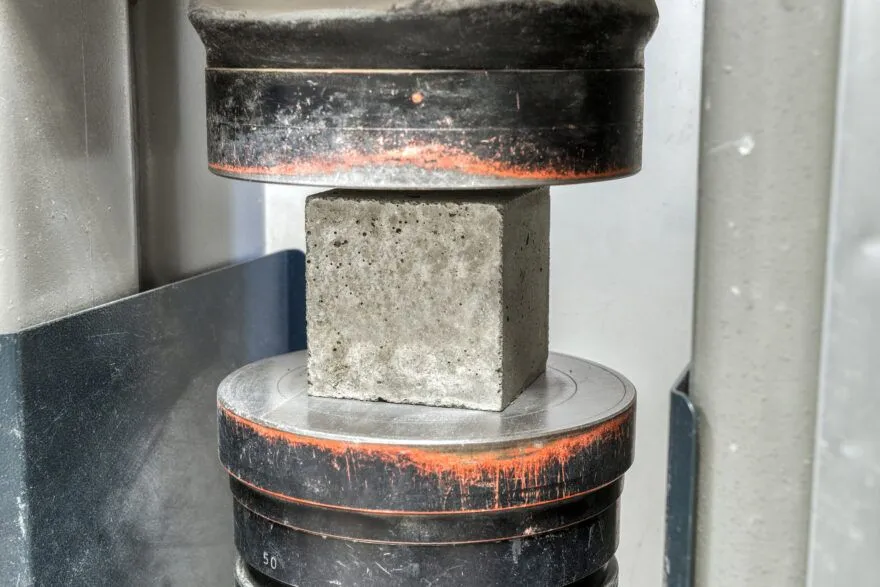
At seven days, the specimens are tested to observe early strength gain. This gives engineers an early warning if the mix is behaving unusually. At twenty-eight days, the concrete reaches its characteristic strength, and the laboratory crush tests reveal the final compressive strength. If the results meet or exceed the required values, the mix is approved for site use. If not, engineers adjust the design or materials until it does.

Lab testing builds confidence that the mix design will perform well under ideal conditions. However, real sites rarely behave like laboratories.


3. Field Sampling: Bringing the Lab to the Construction Site

Once concrete is delivered to the site, engineers must confirm that the fresh concrete matches what was approved in the lab. This starts with field sampling. Workers collect concrete directly from the mixer chute or transit mixer after discarding an initial portion. The sample is used to cast cubes or cylinders that will later be crushed to determine the actual field strength.

Proper sampling is essential. Poor sampling introduces errors that may falsely suggest low strength. The method of filling molds, compaction with rods or vibrating tables, and surface finishing all influence the final result. Once molded, field specimens are immediately covered and placed in curing tanks on site. These tanks simulate the controlled environment of laboratory curing.

Field sampling ensures that verification happens throughout the project, not just once at the beginning.


4. On-Site Fresh Concrete Testing: Catching Problems Early

Before concrete is even poured, fresh concrete is tested for workability, which reflects how easily it can be placed and compacted. The most common test is the slump test. The slump value indicates if the mix has too much water, too little water, or unexpected variations.

Engineers also check temperature, setting time, air content in air-entrained mixes, and unit weight. If the slump is too high, the concrete may be weak or prone to segregation. If it is too low, the concrete may be difficult to place or may not fill formwork properly. These simple tests prevent future strength problems by catching issues early.

Fresh concrete testing is the first line of defense against poor-quality concrete.


5. Compression Testing: The Final Proof of Strength

Compression testing is the most widely used method to measure concrete strength. The cured cube or cylinder is removed from the tank, dried, and placed in a compression testing machine. As the load increases, the specimen eventually fails. The maximum load at failure is used to calculate the actual compressive strength.

If the results match the required strength, the concrete is considered structurally safe. If the results fall below expected values, engineers take immediate steps, such as retesting, increasing sampling frequency, or analyzing workmanship and mixing conditions. In extreme cases, load tests or structural strengthening may be required.

Compression testing transforms assumptions into facts.


6. Rebound Hammer and Ultrasonic Pulse Tests: Non-Destructive Verification

Concrete continues to gain strength over time, and sometimes engineers must verify the strength of hardened concrete without damaging the structure. Non-destructive tests make this possible. The rebound hammer measures surface hardness, while ultrasonic pulse velocity tests measure how fast waves travel through the concrete.

These tests are helpful for rapid assessments, detecting internal cracks, identifying weak areas, and determining uniformity across large structures. Although they cannot replace compression tests, they provide valuable insight and help engineers evaluate structural health even years after construction.


7. Core Cutting: When You Need the Truth

Sometimes doubts arise about concrete quality. This may be due to poor curing, unexpected cracks, unusual settlement, honeycombing, or low strength in cube results. In such cases, engineers extract cylindrical cores directly from the structure. These cores are tested in the laboratory to reveal the true in-place concrete strength.

Core testing is the most reliable method to assess actual performance. It helps engineers make decisions about repair, strengthening, or load restrictions. Although core cutting creates small holes, these are filled with non-shrink grout after testing.

Core tests answer the most important question: did the concrete actually achieve the strength needed for safety?


Conclusion: Strength Testing Protects Lives and Structures

Concrete forms the backbone of modern infrastructure, but without proper testing, its performance can never be trusted. Strength testing ensures that every column, beam, slab, and foundation is built exactly the way it was designed. It protects buildings from premature failure, ensures long-term durability, and guarantees safety for the people who use these structures every day.

From controlled labs to real construction sites, the science of strength testing transforms raw materials into reliable structures. Civil engineers rely on evidence, not assumptions, and strength testing is how they make sure every building stands strong.

Concrete in Extreme Conditions: Hot, Cold, and Marine Environments

Concrete in Extreme Conditions: Hot, Cold, and Marine Environments

How concrete survives when nature pushes it to its limits.


Introduction: The Material We Trust in a World That Keeps Testing It

Concrete is everywhere. It holds our homes, bridges, dams, roads, ports, and city skylines together. Yet this material, which seems so strong and permanent, is constantly threatened by the environments we build in. When temperatures rise above forty-five degrees Celsius, when winters freeze and thaw daily, or when salty ocean waves repeatedly hit a structure, concrete quietly undergoes chemical, physical, and structural stress. Most people will never notice these battles happening beneath the surface, but engineers study them closely because the safety of entire communities depends on how concrete reacts to extreme conditions.

Understanding how concrete behaves when the environment becomes hostile is one of the most important parts of civil engineering. The performance of concrete under heat, cold, and marine exposure determines whether a structure lasts decades or deteriorates long before it should. In this blog, we explore how concrete behaves in three of the most demanding environments and what engineers do to ensure it stays strong, durable, and reliable.


1. Concrete in Hot Environments

Temperature has a powerful influence on how concrete behaves, especially during the early stages of hydration. When the weather becomes extremely hot, concrete tends to set too quickly. The rapid evaporation of water prevents proper hydration, leaving the concrete weak and prone to internal cracking. Engineers often observe plastic shrinkage cracks forming on the surface, which can later allow water to seep into the structure and cause long-term damage.

Another challenge in hot climates is maintaining consistent strength. High temperatures can reduce the final compressive strength of concrete because hydration becomes incomplete. For instance, concrete poured in desert regions such as parts of the Middle East requires special cooling techniques, chilled mixing water, and sometimes even night concreting to prevent early-age cracking. The goal is to slow down hydration so the concrete gains strength gradually and uniformly.

To combat these issues, engineers optimize mix design by increasing water retention, using retarders, or incorporating mineral admixtures like fly ash or slag. Shade, foggers, windbreaks, and curing blankets also help reduce surface evaporation. When done properly, even concrete cast under extreme heat can achieve the strength and durability required for long-term performance.


2. Concrete in Cold Environments

Cold temperatures pose a different set of challenges. When fresh concrete is poured in freezing conditions, the water inside the mix can turn to ice before the concrete sets. This disrupts the hydration process, leading to reduced strength, surface scaling, and sometimes complete structural failure. The alternating cycles of freezing and thawing are particularly damaging because water expands when it freezes, exerting tremendous pressure inside the concrete pores. Over time, this repeated expansion creates microcracks that slowly widen and weaken the structure.

In countries with harsh winters such as Canada, Russia, and parts of northern Europe, engineers design concrete to resist freeze-thaw cycles using air-entrainment. This involves introducing microscopic air bubbles that act like pressure-relief chambers. Instead of cracking the concrete, expanding ice moves into these air pockets, allowing the structure to survive the stress.

Heating equipment, insulated formwork, and temperature-controlled curing help protect concrete during construction. Without these measures, the early life of the concrete becomes vulnerable, and once early damage begins, no amount of future curing or repair can restore full strength. Engineers must therefore treat winter concreting as a controlled process that requires constant monitoring and temperature adjustments.


3. Concrete in Marine Environments

Marine environments are among the harshest for concrete structures. The presence of chloride ions in seawater causes steel reinforcement to corrode. Once corrosion begins, it expands the steel, creating internal pressures that crack the surrounding concrete. These cracks allow even more chloride penetration, accelerating deterioration. This is why bridges, ports, offshore platforms, and coastal buildings need specialized materials and designs to survive.

Another major threat in marine environments is sulfate attack. Sulfates in seawater react with hydrated cement paste, forming compounds that expand and weaken the concrete matrix. Over time, this chemical reaction can lead to significant loss of mass and structural stability. Engineers also consider the effect of constant wetting and drying cycles, which place concrete under repeated stress and contribute to surface degradation.

To protect structures in coastal or underwater conditions, engineers use low-permeability concrete, corrosion-resistant reinforcement, protective coatings, and supplementary cementitious materials such as silica fume or fly ash. In many cases, cathodic protection systems are added to actively prevent corrosion. When designed correctly, concrete in marine environments can last for decades, but it requires careful planning, attention to detail, and thorough material selection.


Conclusion: Concrete Survives When Engineers Think Ahead

Concrete is strong, but extreme environments test its limits constantly. Heat accelerates drying and weakens early strength. Cold freezes water inside its pores and breaks it from within. Marine environments attack concrete chemically and physically, threatening its durability. The real challenge lies not in building with concrete but in understanding how it interacts with its surroundings.

Engineers ensure durability by modifying mix designs, using advanced admixtures, altering curing methods, and sometimes redesigning entire structural systems. When these strategies are applied properly, concrete can endure even the most extreme conditions on Earth. In the end, the resilience of concrete is not only a result of its material properties but also the knowledge, experience, and foresight of the engineers who design with it.

Ultra-High-Performance and Fiber-Reinforced Concrete

Ultra-High-Performance and Fiber-Reinforced Concrete: The Future of Strong, Smart Structures

Concrete has always been strong — but now it’s becoming almost unstoppable.

For more than a century, ordinary concrete shaped our cities, bridges, dams, and homes. But today’s infrastructure demands more than just strength. We need materials that can survive earthquakes, storms, fire, explosive loads, and decades of weathering without cracking or degrading. Traditional concrete simply can’t keep up anymore.

This is why the construction world is turning toward Ultra-High-Performance Concrete (UHPC) and Fiber-Reinforced Concrete (FRC) — two advanced materials that have transformed the possibilities of modern engineering. From ultra-slender bridges to disaster-resilient buildings, these materials are enabling structures that once seemed impossible.

In this blog, let’s break down what makes UHPC and fiber-reinforced concrete so extraordinary, how they work, and where you’ll see them shaping the future.


1. What Makes Ultra-High-Performance Concrete Different?

Ultra-High-Performance Concrete is not just “strong concrete.” It is a carefully engineered composite material with enhanced packing density, low porosity, and extremely high strength.

UHPC can reach compressive strengths of 150–250 MPa, several times higher than high-strength concrete used in skyscrapers. The secret lies in how UHPC is formulated. Instead of large aggregates, UHPC uses fine powders such as silica fume, quartz flour, and very fine sand. This drastically reduces voids and weak points inside the mix.

The result is a concrete that behaves more like a dense ceramic than a porous rock. Its durability is unmatched. UHPC absorbs less water, resists chloride penetration, and remains stable even in aggressive marine environments. This makes it ideal for long-span bridges, protective structures, and infrastructure that must last more than 100 years without major maintenance.


2. Fiber-Reinforced Concrete: Strength That Comes From Within

While UHPC relies on material chemistry, Fiber-Reinforced Concrete gets its strength from internal reinforcements. Fibers act like tiny reinforcements distributed throughout the mix. When cracks try to form, fibers bridge the gap, hold the concrete together, and prevent failure.

Fiber-reinforced concrete can use different fiber types depending on performance needs. Steel fibers enhance structural toughness and load resistance. Synthetic polypropylene fibers reduce plastic shrinkage cracks and improve fire resistance. Glass and basalt fibers help resist chemicals and heat. Carbon fibers offer extremely high tensile capacity for specialized applications.

Unlike traditional reinforced concrete, which depends on steel bars placed in specific locations, FRC distributes strength throughout the entire matrix. This makes it especially useful in areas prone to cracking, impact, or vibration. Even after cracking, FRC retains structural integrity far better than ordinary concrete.


3. UHPC + Fibers: A Combination That Changes Everything

When ultra-high-performance concrete is paired with steel or synthetic fibers, the material becomes even more powerful. UHPC by itself is already strong, but once fibers are added, it gains ductility and tensile resistance.

This allows engineers to design structures that use less material while offering higher performance. For example, precast UHPC panels can be made extremely thin while still carrying heavy loads. Bridges built with UHPC girders require fewer components, reducing maintenance and construction time.

Fiber-reinforced UHPC is also used in blast-resistant structures, high-rise buildings, and architectural forms where ultra-thin elements create dramatic designs without sacrificing safety. The synergy between dense matrix and fibers results in performance levels unmatched by traditional concrete.


4. Applications That Prove the Power of These Materials

Ultra-high-performance and fiber-reinforced concretes have moved from research labs to real-world use. One remarkable example is the Mars Hill Bridge in Iowa, one of the first UHPC bridges in the United States. Its UHPC joints and girders allowed engineers to build a stronger, longer-lasting bridge with fewer components and faster installation.

Fiber-reinforced concrete shines in industrial floors, tunnel linings, and airport pavements, where cracking and heavy loads are common. Many high-rise buildings now use FRC in slabs and shear walls to improve ductility during earthquakes.

In coastal infrastructure, UHPC’s resistance to chloride penetration makes it far more durable than traditional concrete. Its ability to withstand extreme wear and harsh environments extends the lifespan of marine structures, breakwaters, and offshore platforms.


5. Challenges and What Engineers Must Consider

Despite their advantages, these advanced concretes come with challenges. UHPC can be expensive to produce due to its fine ingredients and high cement content. It requires precise mixing and specialized equipment. Fiber-reinforced concrete demands careful fiber distribution to avoid clumping or uneven performance.

Engineers must also consider workability, curing conditions, and quality control. Although UHPC and FRC offer unmatched performance, they must be used strategically. In critical structures or long-term installations, the extra cost is justified by reduced maintenance and exceptional durability.

The future, however, looks promising. As production techniques improve, the cost gap is narrowing. More countries are adopting UHPC standards, and fiber technology is advancing rapidly. With each breakthrough, these materials become more accessible for mainstream construction.


6. The Future: Smarter, Stronger, and More Sustainable Concrete

What makes ultra-high-performance and fiber-reinforced concrete so exciting is not just their strength. It’s their potential to reshape how we build in the era of climate change and rapid urban growth. Stronger materials mean longer lifespans. Improved crack control reduces the risk of sudden failures. Higher durability reduces the need for repairs, lowering carbon emissions from maintenance.

Imagine bridges that last centuries, buildings that withstand earthquakes with minimal damage, and coastal defenses that resist relentless waves without constant replacement. UHPC and FRC are pushing civil engineering toward this future.


Conclusion

Ultra-High-Performance Concrete and Fiber-Reinforced Concrete are more than just materials. They represent a shift in how we think about strength, durability, and long-term resilience. As cities continue to grow and infrastructure demands increase, UHPC and FRC offer powerful solutions that stand far above traditional concrete.

Engineers who understand these materials gain the tools needed to design structures that are not only stronger but smarter. The future of construction is being shaped right now, and UHPC and fiber-reinforced concrete are leading the way.

High-Performance Concrete and Admixtures

High-Performance Concrete and Admixtures: Building the Future of Stronger, Smarter Structures

Why tomorrow’s buildings depend on what we mix into concrete today.


Introduction: The Quiet Revolution Inside Every Concrete Mix

Concrete looks simple from the outside. Grey, rough, ordinary. Yet inside this everyday material is a complex science that decides whether a building will last decades or centuries. A bridge that stands firm during an earthquake, a tower that resists fire, a marine structure that faces saltwater for fifty years without failing — none of this is possible with traditional concrete alone.

Modern infrastructure demands more strength, more durability, and more resilience than ever before. This is where high-performance concrete (HPC) and advanced admixtures step in. They transform a conventional mix into a material that can survive the harshest conditions, carry heavier loads, and still remain workable and economical.

High-performance concrete is not just stronger concrete. It is concrete engineered with intelligence. And admixes are the tools that make this transformation possible.


1. What Makes Concrete “High-Performance”?

High-performance concrete is defined not by one property, but by how many enhanced characteristics it can achieve simultaneously. The goal is to create a mix that performs better than normal concrete in terms of strength, durability, workability, permeability, and long-term resistance.

Engineers design HPC to resist aggressive environments, from industrial chemicals to extreme temperatures. It is used in long-span bridges, high-rise towers, coastal buildings, nuclear facilities, fast-track construction, and roads that carry enormous traffic loads. Traditional concrete simply cannot meet these demands without advanced modifications.

The power of HPC lies in how different properties can be engineered together depending on the project’s needs. Each building becomes a custom mix with its own performance signature.


2. Why Ordinary Concrete Falls Short in Modern Construction

Traditional concrete is strong in compression but often weak in durability. Water penetration, micro-cracks, chemical attack, and temperature changes gradually reduce its strength. Structures today face far harsher conditions than those of the past — heavier loads, faster construction timelines, polluted environments, and more extreme weather events.

Ordinary mixes also struggle with achieving both strength and workability. If you increase cement to improve strength, the concrete becomes harder to place and more prone to shrinkage. If you add more water to improve workability, strength and durability drop. This trade-off limits what conventional concrete can achieve.

Modern expectations require materials that do not force engineers to choose between strength, speed, or durability. High-performance concrete solves this dilemma.


3. The Science of Admixtures: Small Additions, Massive Impact

Admixtures are chemical or mineral additives added to concrete to modify its properties. A few hundred milliliters of admixture can completely change how a cubic meter of concrete behaves. These enhancements include faster strength gain, reduced water demand, better flowability, resistance to corrosion, and control over setting times.

Admixtures do not replace cement. They optimize it. By controlling hydration, reducing porosity, or altering particle interactions, admixtures make concrete smarter and more adaptable to modern challenges. Without them, high-performance concrete would simply not exist.


4. Types of Admixtures and How They Transform Concrete

Water-Reducing and Superplasticizer Admixtures

These admixtures reduce the amount of water needed while maintaining workability. High-range water reducers, often called superplasticizers, make concrete highly flowable without increasing water content. This allows engineers to create dense, strong mixes with low permeability while still pouring and pumping with ease.

Accelerators and Retarders

Accelerators speed up hydration, allowing faster construction in cold conditions or for projects with strict deadlines. Retarders slow down setting time, giving crews more working time in hot climates. These admixtures give engineers control over time itself.

Air-Entraining Admixtures

Air-entraining admixtures introduce tiny uniform air bubbles into the mix, improving freeze–thaw resistance. Roads and bridges in cold regions depend heavily on this technology to prevent cracking when water freezes inside concrete.

Pozzolanic and Mineral Admixtures

Materials such as fly ash, silica fume, GGBS, and metakaolin enhance concrete by filling micro-voids, reducing permeability, and increasing long-term strength. These mineral admixtures create dense, durable concrete that can survive chemical attack, saltwater exposure, and heavy industrial use.

Corrosion Inhibitors

These admixtures protect steel reinforcement from rusting by reducing chloride penetration and improving alkalinity. Marine structures, bridges, and foundations in coastal towns rely heavily on corrosion inhibitors to extend life expectancy far beyond conventional concrete.

Each admixture type unlocks a different performance upgrade. Combined, they create concrete with capabilities that would have been impossible a few decades ago.


5. HPC in Real Projects: Where Performance Matters Most

High-performance concrete is not theoretical. It is used daily in some of the world’s most demanding structures.
Bridges that span hundreds of meters rely on HPC to limit cracking and handle enormous tensile forces. Coastal buildings use HPC mixes with silica fume and corrosion inhibitors to survive chloride-rich environments. High-rise towers like Burj Khalifa use superplasticized mixes with mineral admixtures to achieve high strength without sacrificing workability.

In transportation infrastructure, HPC enables highways that resist rutting, cracking, and freeze–thaw cycles. In dams and marine piers, HPC reduces water seepage and chemical erosion. Across every continent, HPC is proving itself as a cornerstone of advanced civil engineering.


6. Design Considerations: Crafting the Perfect HPC Mix

Designing high-performance concrete requires understanding interactions between cement chemistry, aggregate quality, admixture dosage, and moisture conditions. HPC mixes must balance strength, flowability, setting time, and durability. Too much silica fume can reduce workability. Too little superplasticizer can cause honeycombing. Improper mineral admixture proportions can result in long-term strength loss.

Engineers use laboratory tests to optimize mixes, adjusting particle packing, water–cement ratio, hydration heat, shrinkage behavior, and chloride permeability. A single HPC mix may undergo dozens of iterations before final approval. This is why high-performance concrete is a craft as much as it is a science.


7. The Future: Smart Concrete, Self-Healing Materials, and Nano-Admixtures

The next generation of HPC is already emerging. Researchers are developing self-healing concrete that repairs its own cracks using bacteria or chemical capsules. Nano-silica admixtures enhance hydration at microscopic levels. Carbon-fiber reinforced HPC mixes allow ultra-slender structures that still hold massive loads.

As climate change intensifies, cities will need concrete that performs under heat, saltwater, storms, and aggressive environmental cycles. High-performance concrete is not just an advancement. It is a requirement for the future.


Conclusion

High-performance concrete represents the evolution of one of humanity’s oldest building materials. What makes it revolutionary is not its appearance, but the intelligence engineered into every grain of cement and every drop of admixture. As structures grow taller, loads increase, and environments become more extreme, HPC becomes the silent partner enabling stronger, safer, and more durable infrastructure.

Engineers today are not just mixing concrete. They are designing materials that will define the strength of tomorrow’s world.

Treated Timber & Bamboo Piles for Flood-Resilient Housing

Treated Timber & Bamboo Piles for Flood-Resilient Housing

Ancient wisdom meets modern engineering for safer homes in rising waters.


Introduction: An Old Material With a New Purpose

When rising water threatens a home, the strength of its foundation becomes the difference between survival and collapse. Concrete may be strong, steel may be precise, but in some of the most flood-prone communities around the world, the answer to resilience has been quietly present for centuries. Treated timber and engineered bamboo piles, once dismissed as “traditional,” are now returning as powerful tools in modern flood-resistant construction. With the right engineering, these natural materials can outperform more expensive systems and create foundations that stand firm when water levels rise.


Why Foundations Fail in Flood Zones

Floodwater does not damage a foundation only by force. It erodes soil around the base, removes support below the pile tip, softens clay layers, increases buoyant uplift, and introduces lateral currents that push foundations sideways. When a concrete pile loses embedment due to scour, its vertical capacity drops sharply. When soil becomes saturated, conventional shallow footings settle unevenly and crack the superstructure above. In repeated flood cycles, even well-reinforced structures can lose stability.

Engineers have learned that resilience in flood zones is not always about raw strength. It is about adaptability, soil compatibility, and the ability of the foundation to maintain integrity even when the surrounding ground weakens. This is exactly why treated timber and bamboo piles have survived in river towns, deltas, and coastal settlements for generations.


What Are Treated Timber and Bamboo Piles?

Treated timber piles are long, straight wooden logs strengthened through processes that protect them from decay, insects, and moisture. When submerged below the groundwater line, timber becomes highly durable because the absence of oxygen prevents rot. This is why centuries-old timber foundations in Amsterdam still support buildings today.

Engineered bamboo piles work on a similar philosophy. Bamboo is naturally strong in tension and surprisingly resilient under cyclic loads. Modern techniques compress bamboo fibres or combine them with waterproof resins and coatings, transforming them into lightweight but durable foundation elements. When used in clusters rather than single piles, bamboo foundations distribute loads efficiently and respond flexibly to soil movement.

These are not weak substitutes. They are engineered natural materials designed to behave predictably under flood stress.


Why Timber and Bamboo Perform Well in Flood-Resilient Housing

One of the most compelling qualities of both materials is their flexibility. Unlike rigid concrete piles, timber and bamboo bend slightly under lateral water forces rather than cracking. This flexibility allows them to absorb and dissipate energy from waves or fast-moving floodwater. In soft alluvial soils, where excessive rigidity leads to brittle failure, flexible piles perform exceptionally well.

Another advantage is their compatibility with the soil. Timber piles drive smoothly without fracturing, even in mixed sediments. Bamboo piles can be installed in groups, increasing redundancy and stability. When floods recede, these materials adapt to soil rebound without introducing large internal stresses. More importantly, they are far more affordable and quicker to install in regions where budgets are tight and rapid construction is essential.

In many Southeast Asian villages built along rivers, bamboo pile systems have kept homes stable for decades despite annual monsoon floods. Their performance is not accidental; it is a combination of material behaviour and clever engineering.


Treatment and Design Considerations

For timber piles to remain durable, engineers ensure they remain below the permanent water table where oxygen cannot reach. Additional treatment with preservatives or pressure-impregnated chemicals protects portions above water. Bamboo requires resin coatings, thermal treatment, or lamination to resist decay. Both materials must be cut, handled, and stored carefully to prevent early deterioration.

Designing these foundations requires attention to pile spacing, embedment depth, soil-bearing conditions, and expected flood loads. In sandy soils with high scour potential, deeper embedment and cluster installation improve stability. In clay soils, using larger-diameter timber or grouped bamboo piles distributes load better. A well-designed timber or bamboo foundation is not a temporary fix; it is a long-term strategy that gains strength when paired with elevated superstructures.

A notable example comes from the Netherlands, where timber piles driven centuries ago still hold historic waterside houses. Similarly, communities in Vietnam and Indonesia rely on engineered bamboo foundations for stilted homes, allowing structures to survive seasonal floods with minimal maintenance. These real cases show that when designed correctly, natural pile systems are far more durable than their reputation suggests.


Challenges and How Engineers Overcome Them

Despite their advantages, timber and bamboo face skepticism. Many assume these natural materials decay rapidly, but this concern usually comes from improper installation or inadequate treatment. Modern preservation techniques have extended their lifespan dramatically, often matching that of reinforced concrete in wet conditions.

Regulatory codes are another challenge, as many regions lack updated guidelines for alternative pile systems. Engineers address this by relying on performance-based design, advanced testing, and hybrid systems that combine timber or bamboo with concrete caps or steel connectors. Maintenance is also straightforward, as inspections can identify early signs of wear long before structural performance is affected.

With the right engineering, these challenges become manageable rather than limiting.


How Engineers Integrate These Foundations Into Flood-Resistant Housing

The process begins with a detailed geotechnical survey to understand soil behavior during saturation and flooding. Engineers then choose between timber and bamboo based on soil stiffness, waterlogging patterns, expected lateral loads, and availability of materials. Once installation begins, quality control becomes crucial. Pile driving must be precise, treatments must remain intact, and clusters must be aligned properly.

After construction, the foundation’s performance is monitored through settlement checks and periodic inspections. When paired with elevated floor systems, lightweight walls, and proper drainage design, timber and bamboo piles become part of an integrated flood-resilient housing strategy that is both affordable and effective.


Conclusion

Flood-resilient housing demands foundations that can work with water rather than fight against it. Treated timber and engineered bamboo piles offer unique advantages that modern materials sometimes struggle to match, especially in soft, waterlogged soils. Their flexibility, durability, affordability, and long history of success make them strong candidates for communities facing increasingly frequent floods. As climate change intensifies these events, rediscovering and modernizing these natural foundation systems is not just a technical choice. It is a practical, sustainable, and culturally grounded solution for safer homes.

Reinforced Concrete for Flood-Resilient Housing: Structure and Foundation

Reinforced Concrete for Flood-Resilient Housing: Structure and Foundation

Why the strongest material in construction becomes even more essential when the waters rise.


Introduction: When Water Becomes the Real Test of a Building

Floods do not knock politely before entering a home. They come with force, speed, unpredictability, and an ability to destroy everything built without careful engineering. When floodwaters rise, they test a building’s weight, stability, foundations, joints, anchorage, and resistance to scour. Many materials that perform well in normal environments fail instantly during flood exposure. But reinforced concrete, when used strategically, can transform an ordinary structure into a flood-resilient system capable of withstanding water pressure, soil movement, and erosion.

Designing for floods is not only about elevating homes or diverting water. It is about creating foundations and structural systems that remain stable even when soil weakens, water forces increase, and hydrostatic pressure pushes from every direction. This is where reinforced concrete becomes one of the most effective tools civil engineers have today.


1. Why Reinforced Concrete Performs Well in Flood Conditions

Reinforced concrete combines compressive strength from concrete and tensile strength from steel reinforcement. Floods create forces such as uplift, lateral water pressure, buoyancy, and scour. These forces require a material that does not soften, weaken, or deform when wet. Reinforced concrete maintains structural integrity even under prolonged water exposure if designed with proper cover, mix proportions, and reinforcement detailing.

Beyond strength, concrete also resists impact from floating debris, a common cause of wall failures during flash floods. Its mass gives it stability, reducing buoyancy forces that might otherwise lift lighter structures off their foundations. This combination of mass, stiffness, and reinforcement creates a level of reliability that other materials struggle to match.


2. Foundations for Flood-Resilient Structures: What Engineers Consider First

Flood-resilient housing begins with the foundation. Soil near rivers, deltas, or coastal zones weakens when saturated. Engineers therefore design foundations that bypass weak layers and remain stable under changing moisture conditions. Deep foundations, such as reinforced concrete piles, are especially effective because they transfer building loads to stronger soil strata below.

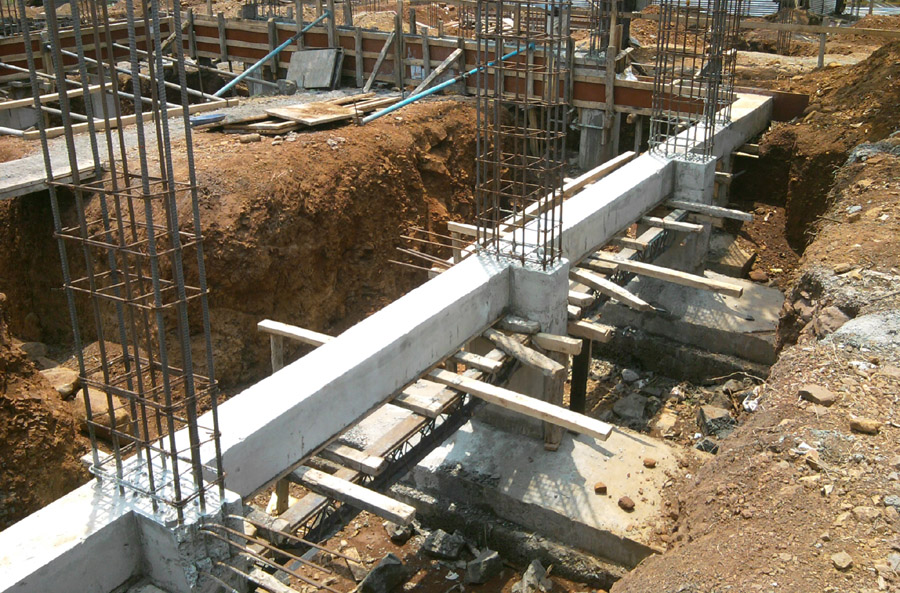
Another approach is designing reinforced concrete grade beams and pile caps that tie the entire foundation together, distributing uplift and lateral forces. During floods, water can erode soil around foundation edges, a process called scour. Reinforced concrete foundations resist scour more effectively because they maintain shape and strength even when partially exposed.

The goal is not only to support the home in dry conditions but to ensure the foundation remains reliable when water causes rapid soil loss.


3. Elevated RC Platforms: A Critical Component of Flood Design

One of the most successful design strategies for flood-prone regions involves building homes on elevated reinforced concrete platforms. These platforms raise living spaces above expected flood levels while providing a rigid structural base resistant to water and debris impact.

The elevation height depends on hydrological data, historical flood maps, and climate projections. Engineers often design these platforms as monolithic slabs supported by reinforced concrete columns or piles. This monolithic approach reduces weak joints and makes the structure behave as a solid unit during flooding.

Elevation not only protects against direct water entry but also reduces the risk of prolonged moisture exposure, which can damage interior finishes and utilities.


4. Reinforcement Detailing: Where Strength Truly Comes From

Concrete alone cannot handle the tension and cracking forces generated during floods. Proper reinforcement detailing determines whether a structure survives. Engineers provide extra reinforcement in foundations, beams, and columns in flood zones, especially in regions where lateral water forces are high.

Critical reinforcement practices for flood-resilient structures include adequate concrete cover to protect steel from corrosion, closed stirrups for confinement, continuous bars for shear resistance, and anchorage that prevents uplift failure. These details ensure that the structure behaves predictably even when water forces are unexpected.

Good detailing often makes the difference between a building that withstands water and one that collapses despite using reinforced concrete.


5. Scour and Erosion Protection: The Often-Ignored Failure Mechanism

Many buildings collapse because soil supporting their foundations is washed away during floods. This phenomenon, known as scour, removes soil from around footings and piles, leaving concrete members unsupported. Even a strong structure can fail if the ground beneath it disappears.

Engineers mitigate scour by designing reinforced concrete grade beams, deeper footings, protective riprap layers, and geotextile linings. These measures prevent rapid soil loss during high-velocity water flow. In severe flood regions, entire foundations may be encased in reinforced concrete jackets to stop erosion from undermining the structure.

Scour protection is especially important for riverside and coastal housing.


6. Case Studies: When Reinforced Concrete Made the Difference

Case Study 1: Kerala Floods, India (2018)

During the devastating Kerala floods, many traditional masonry homes collapsed because they lacked anchorage and had shallow foundations. However, reinforced concrete homes built on pile foundations survived even when surrounding soil eroded. Engineers found that RC piles carried loads effectively even after significant scour, demonstrating the importance of deep foundations.

Case Study 2: Hurricane Katrina, USA (2005)

In Louisiana, elevated reinforced concrete homes performed significantly better than non-elevated timber homes. The mass and stiffness of reinforced concrete resisted storm surge and floating debris impact. Reports from FEMA concluded that RC structures had the lowest failure rate among all building types exposed to the surge.

Case Study 3: Bangladesh Raised Plinth Homes

In Bangladesh, millions of homes were rebuilt on reinforced concrete plinths that elevate structures above seasonal floodwaters. These plinths dramatically reduced collapse rates and allowed communities to remain in place even during severe monsoon seasons.

These cases show that reinforced concrete, when properly detailed and combined with flood-resilient design, can prevent catastrophic failure.


7. Designing RC Homes for Future Climate Conditions

Climate change is intensifying rainfall patterns and increasing flood frequency. Engineers must now design reinforced concrete homes based on projected future flood levels, not historical averages. This means higher plinths, stronger foundations, improved drainage, and heavier lateral load design.

More advanced solutions involve integrating RC structures with amphibious systems, floating foundations, or hybrid elevated-amphibious platforms. The flexibility of reinforced concrete allows these systems to adapt to rising water levels while offering decades of durability.

Flood-resilient housing is no longer optional. It is a necessary step in adapting to our changing world.

Floodproofing: Designing Buildings to Withstand the Water

Floodproofing: Designing Buildings to Withstand the Water

The Most Dangerous Force in Construction Isn’t Fire or Wind. It’s Water.

Most people imagine fires, earthquakes, or storms when they think about disasters. But the truth is that water causes more property damage globally than any other natural force. It does not roar like a cyclone or shake the ground like an earthquake. It rises quietly, steadily, and relentlessly, turning homes unlivable and foundations unsafe. For civil engineers, floodproofing has become one of the most essential responsibilities of modern design, especially as climate change triggers more intense rainstorms, rising seas, and unpredictable weather patterns.

Floodproofing is not a single solution. It is an entire engineering philosophy that understands how water behaves, how soil reacts, how loads shift, and how materials deteriorate. Designing flood-resistant buildings involves smart planning, site evaluation, structural innovation, and real lessons learned from failures around the world.

This blog will break down how buildings can be designed to withstand flooding, what techniques engineers use, and what real case studies teach us about prevention.


1. Understanding Flood Behavior: The First Step in Floodproof Design

Floodproofing begins with understanding how water moves. Civil engineers must evaluate whether water at the site will rise vertically, flow horizontally at high speed, seep underground, or accumulate slowly over time.

A building facing river overflow deals with different forces compared to one in a coastal storm surge. Engineers study topography, drainage paths, rainfall intensity, tidal data, soil type, and historical flood records. In many cases, the ground itself becomes a hazard because saturated soil loses strength. Floodproof design therefore begins with geotechnical studies that determine how much pressure the soil can take and how deep foundations must extend to stay stable during saturation.

Once the behavior is understood, engineers select strategies that prevent failure rather than simply resisting water.


2. Elevation: The Most Effective Strategy in Flood-Prone Regions

Elevation is one of the oldest and most effective floodproofing techniques. By raising a home above predicted flood levels, engineers ensure the structure remains dry even when surrounding land is underwater. This method is widely used in coastal towns, river basins, and low-lying rural regions.

Elevated buildings may use reinforced concrete stilts, masonry piers, or engineered timber piles. The height depends on flood zone maps, local codes, and environmental changes. Modern elevation techniques also consider hydrodynamic forces, meaning water should pass below the home without striking the supports too hard.

Elevation not only protects against water but also reduces long-term maintenance and mold risks. When combined with lightweight materials like fibre-cement boards and treated timber, elevated homes become both affordable and resilient.


3. Dry Floodproofing: Keeping Water Out Through Barriers and Reinforcement

Dry floodproofing is a method where engineers prevent floodwater from entering the building using barriers, sealants, reinforced walls, watertight doors, and pumps. This strategy is suitable for commercial buildings or residential areas where minor to moderate flooding occurs.

The key challenge with dry floodproofing is ensuring that the building can withstand water pressure. If walls are not sufficiently reinforced, they can bow inward or collapse. Civil engineers use hydrostatic pressure calculations to design walls that resist these loads. They also ensure that window frames, wall joints, and utility penetrations are fully sealed.

Modern materials like epoxy-coated barrier systems, rubber gaskets, concrete admixtures, and flood-resistant insulation make dry floodproofing more effective than ever.


4. Wet Floodproofing: Allowing Water In Without Causing Damage

Wet floodproofing sounds counterintuitive but is highly effective for minimizing damage. Instead of fighting water entry, the building is designed so that water can enter and exit without damaging critical components. This method works well for basements, garages, crawl spaces, and lower levels of buildings in frequent flood zones.

Engineers elevate electrical systems, use flood-resistant materials, design easy drainage paths, and protect essential utilities. By equalizing internal and external water pressure, the structure stays stable and avoids collapse.

Wet floodproofing is often used in combination with elevation or shoreline protection.


5. Foundation Design: Building a Base That Survives Saturation

Flooding affects soil strength. When soil becomes saturated, it loses friction and can no longer support loads effectively. Engineers overcome this by designing deep foundations such as pile foundations, drilled shafts, or reinforced concrete piers.

For clay-rich soils, engineers must consider swelling and shrinkage caused by water fluctuations. Sandy soils may erode quickly, so scour protection becomes necessary. Proper drainage layers, geotextiles, and gravel beds help stabilize foundations in flood-prone areas.

In coastal regions, corrosion-resistant reinforcement and concrete mixes with low permeability protect foundations from saltwater damage.


6. Site Planning: The Hidden Layer of Floodproofing

Flood-resistant design extends far beyond the building itself. Ideal site planning considers natural water flow, vegetation patterns, swales, retention ponds, permeable pavements, and landscape grading. A well-planned site helps redirect water away from structures and improves safety.

Engineers use contour maps, stormwater models, and hydrological simulations to design layouts that handle heavy rainfall. In many cases, a building survives because the site was planned intelligently.


7. Materials That Resist Water Damage

Floodproof structures require materials that do not rot, warp, swell, or corrode. Common materials include reinforced concrete, pressure-treated timber, galvanized steel, water-resistant gypsum, PVC boards, and closed-cell insulation.

Engineers avoid materials like untreated wood, fiberboard, carpets, and low-quality plaster because they deteriorate rapidly when exposed to water.

Material selection plays a major role in long-term performance and maintenance costs.


8. Case Studies: Real Lessons from Floodproofing Failures and Successes

Case Study 1: New Orleans, USA – Hurricane Katrina (2005)

When the levees in New Orleans failed, more than 80 percent of the city flooded. Many homes were not elevated and sat directly at or below sea level. Structural damage was caused not only by water but by the pressure created when water filled basements.
What would have prevented it?
Higher elevation standards, stronger levee protection systems, and wet floodproofing for basements. Katrina transformed U.S. flood design codes forever.

Case Study 2: Kerala, India – 2018 Floods

Kerala experienced one of the worst floods in nearly a century. Many homes built along rivers lacked elevation and had shallow foundations unsuitable for saturated soils.
What would have prevented it?
Better site selection, elevation strategies, and foundations designed for lateral water loads.

Case Study 3: The Netherlands – Delta Works Success

The Netherlands is known for the greatest flood defense system in the world. Homes are elevated, riverbanks are fortified, and inland water management is highly advanced.
Why does it work?
A combination of elevation, controlled water flow, strong foundations, and national-level engineering planning.


9. Challenges in Floodproofing: What Engineers Must Overcome

Floodproofing is complex because climate change has made historical data unreliable. Rainfall patterns shift, sea levels rise unpredictably, and extreme storms appear more frequent. Engineers must design not only for present risk but for future hazards.

Cost is another challenge. Elevated systems can be expensive for low-income communities. Maintenance is essential, yet many homeowners neglect drainage systems, sump pumps, and barriers.

Despite these challenges, modern engineering offers practical solutions that dramatically reduce damage.


Conclusion: Floodproofing Is Not an Option. It Is a Necessity.

Water may never roar like a hurricane or shake the earth like an earthquake, but it destroys quietly, steadily, and completely if a building is not prepared. Floodproofing is the shield that turns a vulnerable structure into a resilient one. It combines smart design, structural engineering, material science, and lessons learned from real disasters.

In a world where floods are increasing, civil engineers stand at the frontline, ensuring that homes remain safe and communities stay protected. With the right design choices, floodproof buildings can become the standard, not the exception.


References

FEMA. Floodproofing Building Design Requirements. https://www.fema.gov
US Army Corps of Engineers. Flood Mitigation Measures. https://www.usace.army.mil
UNISDR. Global Assessment on Flood Risk. https://www.unisdr.org
Kerala Floods Government Report (2018). https://sdma.kerala.gov.in
Netherlands Delta Works. Government Portal. https://www.government.nl

Amphibious Housing: Designing Homes That Rise With Water

Amphibious Housing: Designing Homes That Rise With Water

How engineering innovation is creating homes that adapt instead of sinking.


Introduction: When the Water Rises, Most Homes Lose. These Homes Don’t.

For generations, people living near rivers, deltas, coasts, and floodplains have accepted one terrifying truth. When floodwaters rise, their homes stand no chance. The structure stays fixed while the water moves freely, destroying everything it touches. But what if a house did not resist water at all? What if it adapted to it? What if the building rose with the flood instead of fighting against it?

This question forms the foundation of amphibious housing, a new category of flood-resilient design where homes float when necessary and rest on land when not. It is an elegant idea with surprisingly deep technical roots, blending buoyancy physics, hydrological studies, materials engineering, geotechnical design, and community-scale planning. As climate change pushes coastal populations into more extreme conditions, amphibious housing asks a simple but revolutionary question: instead of building higher and higher, why not build smarter?


1. What Exactly Is Amphibious Housing?

Amphibious housing is an architectural and engineering strategy where a building remains on the ground under normal conditions but automatically rises during flooding. It is not a full-time floating structure like a houseboat. Instead, it functions as a hybrid. When water levels rise, hidden buoyant systems activate, lifting the home above floodwaters. When water recedes, the house gently returns to its original position.

This adaptive behavior makes amphibious systems fundamentally different from static elevated housing. Elevation requires predicting a single safe height, which is increasingly difficult in regions where floods are unpredictable or intensifying. Amphibious construction avoids the limitations of fixed elevation by allowing the structure to follow the water rather than resist it.

The idea is simple. The engineering behind it is beautifully complex.


2. How Amphibious Structures Work: The Engineering Logic

At the core of amphibious housing is a buoyancy system. The house rests on vertical guides or piles that keep it stable while allowing vertical movement. Under the structure, buoyant chambers, sealed pontoons, or lightweight materials generate lift when water rises. The more the water rises, the more lift these elements provide, keeping the house above the flood level.

Engineers calculate buoyancy carefully. The total lift must exceed the combined dead load and live load of the structure while maintaining stability against lateral forces produced by wind, water currents, and debris impact. To avoid tilting, the buoyant system must be symmetrically aligned and its center of gravity strategically positioned. Geotechnical engineers also study soil behavior since the guiding piles must resist lateral movement even when saturated.

Amphibious foundations rely on passive systems. There are no motors, pumps, or electronics involved. The water itself triggers the response. This makes the design inherently resilient and suitable for low-income flood-prone regions where maintenance budgets may be limited.


3. Advantages of Amphibious Housing in a Changing Climate

The biggest advantage of amphibious housing is adaptability. Unlike fixed elevation, which is designed for a specific predicted height, amphibious systems work across a range of flood levels. This makes them highly suitable for regions experiencing more frequent flash floods or longer flood durations.

Amphibious houses also preserve a natural connection to the ground. Traditional elevated structures may require tall stilts that disrupt access, aesthetics, or community cohesion. Amphibious homes feel like regular houses for most of the year. They only transform when needed.

From a financial perspective, amphibious retrofits can be more affordable than large-scale elevation projects. Communities with tight budgets can convert traditional homes using buoyant foundations and guiding systems without rebuilding from scratch. For governments, amphibious planning can become a cost-efficient adaptation strategy for vulnerable regions rather than relocating entire neighborhoods.


4. Real Examples From Around the World

Amphibious houses are no longer theoretical. Some of the most interesting real-world applications include:

The Netherlands: Maasbommel Amphibious Houses

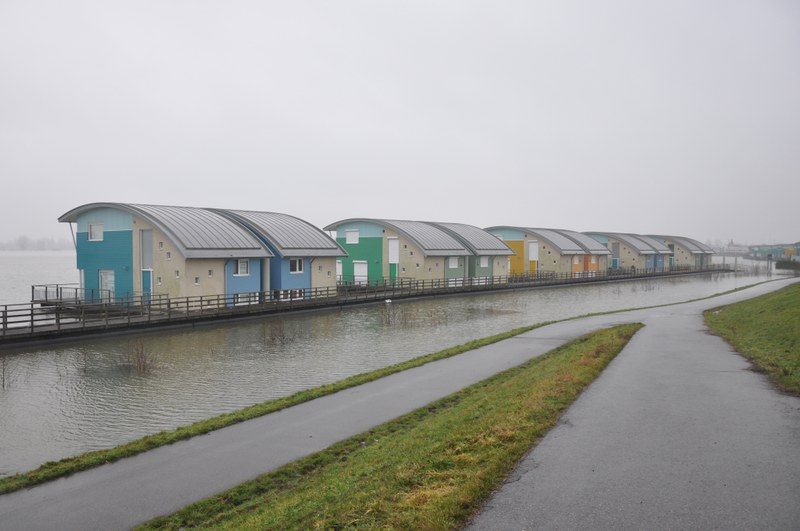
The world’s first modern amphibious neighborhood was built in Maasbommel. These homes rest on concrete pontoons that float upward during floods while steel piles guide vertical movement. They have successfully lifted during multiple high-water events, proving the reliability of the system.

United States: Buoyant Foundation Project, New Orleans

After Hurricane Katrina, the Buoyant Foundation Project developed amphibious retrofits for raised wooden homes. Lightweight flotation blocks and vertical guides allowed historic homes to float without altering their architecture. This showed that amphibious systems are not limited to new construction.

Bangladesh: Low-Cost Amphibious Schools

In flood-stricken rural Bangladesh, amphibious schools using bamboo frames and steel barrels have operated for years. These structures rise during monsoon floods, ensuring that education continues even during extreme weather.

These examples highlight how amphibious housing can work in advanced nations and low-resource communities alike.


5. Challenges and the Path Forward

Despite its promise, amphibious housing faces challenges. Building codes in many countries do not yet include provisions for floating foundations, making approvals difficult. Engineers must also address long-term material durability, especially in regions with corrosive water or strong currents. Community acceptance can also be a hurdle since many people initially hesitate to trust a home designed to float.

However, the increasing frequency of extreme floods is shifting perspectives. As climate change continues to reshape coastlines, cities, and river systems, amphibious strategies may soon move from experimental to essential. Collaboration between civil engineers, hydrologists, architects, and policymakers will determine how quickly this technology becomes mainstream.


Conclusion: A Future Where Homes Don’t Just Survive Floods — They Adapt to Them

Amphibious housing represents a shift in mindset. Instead of building higher, communities are learning to build smarter. Instead of resisting water, they are learning to live with it. And instead of accepting catastrophic flood damage as inevitable, engineers are designing systems that transform danger into movement and movement into safety.

As rising seas and unpredictable storms challenge traditional construction, amphibious homes offer a powerful alternative. They show that resilience is not about standing still but about learning to move.